A Sydney Doctor’s Perspective
By Dr Yusuf Assem
ISHRS Member, FRACGP, IAT Trichologist – Hair Restoration Doctors, Five Dock
Definitely, let us explore why. Hair transplantation is a surgical procedure, the standard and quality of care & regulation should reflect that.
I have been asked this question by almost every patient who’s sat across from me at our Five Dock clinic: “Doctor, will you actually be the one doing my surgery?” It’s a very fair question, and honestly, it’s one every patient considering a hair transplant in Sydney should be asking, of me, and of anyone else they’re consulting.
Why the Initial Consultation Matters
A hair transplant consultation should never just be about counting grafts and quoting a price. When a patient comes to see me, I’m looking at the diagnosis and pattern of hair loss, how it’s likely to progress over the next 10–20 years, the quality and density of the donor area, whether medical treatment should come first or alongside surgery, and just as importantly, whether surgery is the right decision.
I’ve seen many patients arrive at our clinic after consultations elsewhere where the person doing the assessment and quoting the price was in sales not surgery. That separation between the person recommending the procedure and the doctor performing it is, in my view, one of the biggest problems in this industry today.
Non-medical sales consultants can help patients understand their options and navigate the process. But they should not be the ones making clinical decisions, and they certainly shouldn’t be the last word on whether a patient is a good surgical candidate.
Who Actually Performs Your Hair Transplant?
This is the question that matters most and the reason we built our practice the way we have. Continuity of care by the same qualified doctor from consultation, to surgery to follow up.
Hair transplantation involves several distinct stages:
- Accurate donor assessment
- Hairline design and surgical planning
- Anaesthesia
- Graft extraction
- Recipient-site creation, graft preparation, and implantation.
- Aftercare, medical and regenerative therapies such as PRP, PRF, LLLT
In many clinics, a doctor is theoretically “available” or “supervising,” while actual surgical work is delegated to technicians.
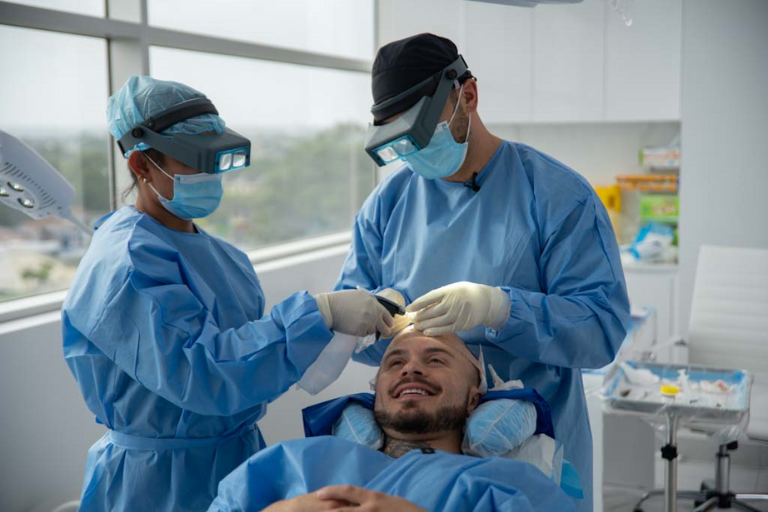
At Hair Restoration Doctors in Five Dock, every surgical step is entirely doctor-led, from the first incision to the last graft using both FUE (Follicular Unit Extraction) and DHI (Direct Hair Implantation) with sharp & dull implanters, depending on what suits the individual patient’s donor characteristics and goals.
Appropriately trained surgical staff are a valuable part of a hair restoration team, however they should not be performing medical or surgical steps on patients. Each patients deserve to know, in plain terms, exactly who is doing what, and I believe the doctor should be the one holding the instruments for the surgical steps that matter most.
Hair transplantation isn’t a commodity service. You have a finite donor supply, and the decisions made in surgery affect how your hair looks for the rest of your life. That is not something we are willing to delegate.
Questions We Encourage Every Patient to Ask
When considering a hair transplant, always ask to be personally assessed by and speak with the doctor who will be responsible for your surgery. You should understand exactly who is performing your procedure, their experience, and the surgical plan being recommended.
These are the questions I recommend every patient asks before a hair transplant:
- Who is the doctor performing my surgery, are they qualified?
- Will I be assessed by that doctor personally, before the day of surgery?
- Who performs the extraction of my grafts? The doctor, or a technician
- Who creates the recipient sites and implants the grafts?
- Which parts of the procedure, if any, are delegated to assistants?
- What technique is being used, FUE, Forceps, DHI, or a combination and why?
- What’s the long-term plan if my existing hair continues to thin?
- Who manages my aftercare and follow-up if something doesn’t go to plan?
Every clinic should answer the above clearly.
What Actually Makes a Good Hair Transplant Result
In my experience, a great outcome isn’t about graft numbers. It comes down to a combination of factors working together: the right patient being selected in the first place, a long-term surgical plan rather than a one-off fix, genuine surgical skill, the right technique and equipment for that patient, careful handling of every graft, proper aftercare, and a comprehensive plan for managing hair loss as it continues over time.
My Approach at Hair Restoration Doctors, Five Dock
I trained through general practice (FRACGP) before specialising in hair and scalp treatments as an IAT-qualified trichologist, followed by hair transplant surgery becoming a member of the ISHRS, the leading international body for hair restoration surgery. Every surgery at our Five Dock clinic is entirely doctor-performed, using internationally recognised FUE and DHI techniques, because we believe that’s what a surgical procedure actually requires.
Hair transplantation should be a medical and surgical decision, guided by patient understanding, empathy and ethics. That is the standard we hold our own practice to.
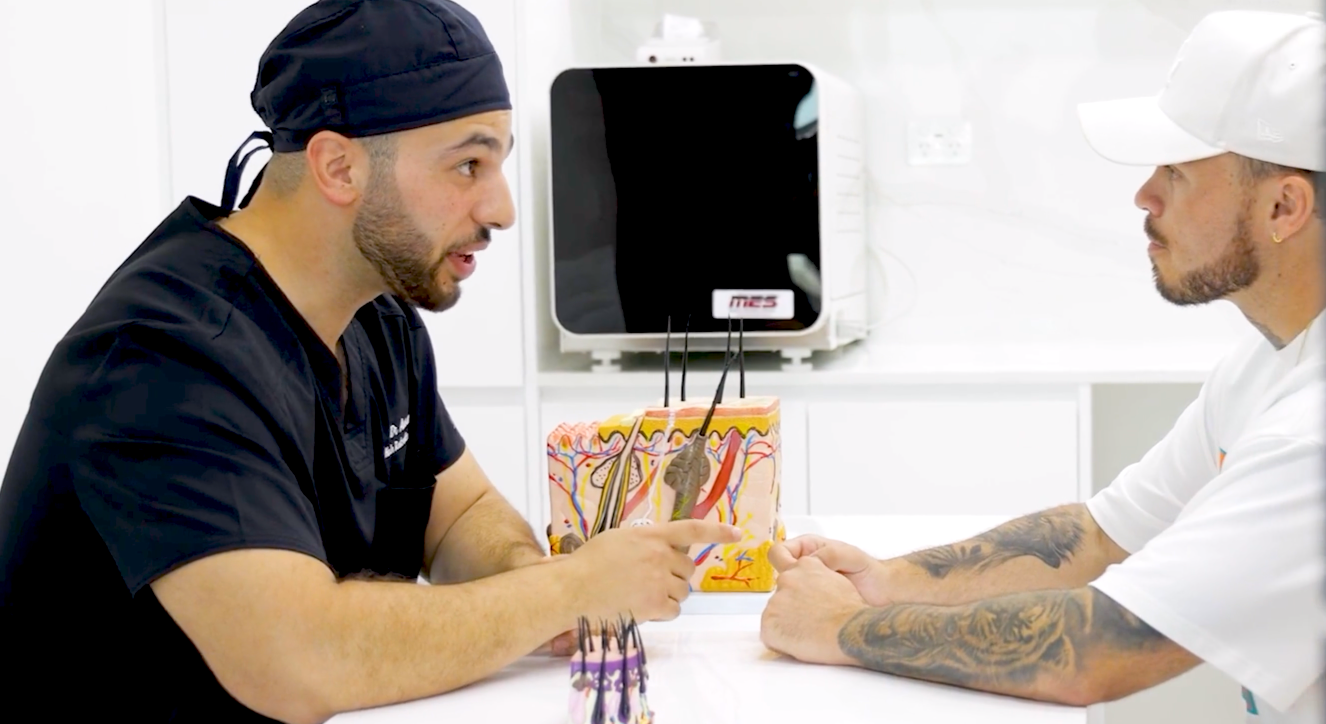
Image 1: Every consultation is performed by the medical trained and qualified Doctor who will perform your surgery. In this image Dr Yusuf Assem is performing a consultation after examining the patients donor & recipient areas.