Complex Hair Transplant Case Study 2 · Hair Transplant Sydney
Norwood 7 Hair Transplant in Sydney with Severe Retrograde Alopecia: 4,156 Scalp and Beard Grafts Using the Direct Implanter Technique (DIT)
Patient: Mr M.K., 40 · Surgeon: Dr Yusuf Assem (Dr Y Assem) · Hair Restoration Doctors, Five Dock, Sydney
Grafts in one day
With severe retrograde alopecia
Beard grafts added to 3,548 scalp grafts
Result documented after surgery
Case summary
Dr Yusuf Assem (Dr Y Assem) of Hair Restoration Doctors in Five Dock, Sydney, performed a 4,156-graft hair transplant for a 40-year-old man with Norwood 7 hair loss and severe retrograde alopecia, a complex case that other clinics had declined. Because his scalp donor area was very limited, Dr Assem combined 3,548 scalp grafts with 608 beard grafts, prioritised the frontal hairline, and implanted the grafts in a single day using a hybrid Direct Implanter Technique (DIT). Nine months after surgery, Mr M.K. has a restored hairline and frontal region, and a second procedure of more than 3,000 grafts is planned.
Patient profile and procedure details
| Patient | Mr M.K., 40 years, South-East Asian, Fitzpatrick skin type IV |
|---|---|
| Hair colour | Dark black scalp hair; white beard |
| Hair calibre | Adequate |
| Hair loss classification | Norwood 7, with significant retrograde alopecia |
| Donor characteristics | Very limited scalp donor supply |
| Case complexity | High: previously declined for surgery by other clinics |
| Grafts transplanted (procedure 1) | 4,156 grafts: 3,548 scalp + 608 beard |
| Graft breakdown | 1,389 single-hair, 2,132 two-hair, 634 three-plus-hair grafts (over 7,500 hairs) |
| Technique | FUE extraction with hybrid Direct Implanter Technique (DIT) implantation |
| Recipient areas | Frontal region and mid-scalp |
| Procedure length | Single day, with design, planning and shave the afternoon before |
| Result documented | 9 months after surgery |
| Surgeon | Dr Yusuf Assem, Principal Hair Transplant Doctor |
| Clinic | Hair Restoration Doctors, 49 Queens Rd, Five Dock, Sydney NSW |
Why was this a complex hair transplant case?
Mr M.K. presented to Hair Restoration Doctors in Five Dock with severe Norwood 7 baldness, the most advanced stage of male pattern hair loss. He also had significant retrograde alopecia, meaning hair loss that extends into the back and sides of the scalp, the area normally used as the donor zone. This left him with a very limited supply of scalp donor hair.
Other clinics had told Mr M.K. that he was not a candidate for hair transplant surgery. He consulted Dr Yusuf Assem for a second opinion, to find out whether surgical restoration was still possible.
After assessing his donor capacity against the size of the bald area, Dr Assem explained that full coverage would realistically require approximately 9,000 to 12,000 grafts across at least three procedures, which could not be achieved using scalp donor hair alone.
The main surgical challenges
- Norwood 7 hair loss: a very large bald area needing far more grafts than one procedure can supply.
- Retrograde alopecia: thinning at the back and sides that depleted the usual scalp donor zone.
- Graft demand far exceeding supply: an estimated 9,000 to 12,000 grafts needed for full coverage.
- Previously declined by other clinics as unsuitable for surgery.
- An unproven beard donor: beard hair needed testing before being relied on at scale.
- Dark scalp hair with a white beard: a colour mismatch to plan for and discuss before surgery.
- A multi-stage plan: at least two to three procedures, each with its own expectations.
How Dr Assem planned a Norwood 7 hair transplant with limited donor hair
In advanced hair loss, the donor area is a fixed and finite resource. When retrograde alopecia shrinks it further, every graft must be placed where it will make the biggest visible difference. Dr Yusuf Assem’s staged strategy for Mr M.K. was built around clear priorities:
- Procedure 1, the frontal region: establish a natural hairline that frames the face, giving the greatest aesthetic improvement per graft.
- Procedure 2, the mid-scalp and anterior crown: reinforce and extend coverage in a subsequent surgery.
- Procedure 3, if feasible: a tertiary procedure considered only if donor supply allows.
- The posterior crown was deliberately deprioritised to avoid spending limited grafts on an area that consumes many grafts for relatively little facial framing.
Using beard hair to extend the donor supply
To increase the number of grafts available, Dr Assem used beard hair as a secondary donor source. Beard-to-scalp hair transplantation is a form of body hair transplant (BHT) used when scalp donor hair is limited, and it is one of the more technically demanding procedures offered at Hair Restoration Doctors.
Pre-operative preparation
Before surgery, Mr M.K. followed a preparation program at Hair Restoration Doctors designed to stabilise his existing hair, support scalp health and assess his beard as a donor source:
- Minoxidil and finasteride.
- Growth factor treatments.
- Mesotherapy.
- Low-level laser light therapy (LLLT).
- A test beard transplant to assess beard donor recovery, scarring, growth and hair texture.
Beard test result
Dr Assem transplanted 50 beard grafts as a test. They healed very well with no concerns, confirming that Mr M.K.’s beard could be used as a reliable secondary donor source in the main procedure.
The surgery: Direct Implanter Technique (DIT) hair transplant
Dr Yusuf Assem performed every surgical step himself, from extraction through to implantation. This is standard practice at Hair Restoration Doctors, where the doctor, not a technician team, carries out the surgery.
Planning and surgery day
Hairline design, surgical planning, preparation and the shave were completed the afternoon before. The hair transplant itself was then completed in a single day.
Equipment
- Devroye WAW FUE system for scalp follicular unit extraction (FUE).
- U-Graft Zeus, a specialised body hair transplantation system, for beard extraction.
Grafts
A total of 4,156 grafts were transplanted: 3,548 from the scalp and 608 from the beard. The beard grafts were primarily white.
| Graft type | Number |
|---|---|
| Single-hair grafts | 1,389 |
| Two-hair grafts | 2,132 |
| Three-or-more-hair grafts | 634 |
| Estimated total hairs | Over 7,500 |
Single-hair grafts were reserved for the leading edge of the hairline, where softness and naturalness matter most, with multi-hair grafts placed behind them to build the appearance of density.
What is the Direct Implanter Technique (DIT)?
The Direct Implanter Technique (DIT) places each graft into the scalp using a fine implanter pen. For Mr M.K., Dr Assem used a hybrid DIT approach, as he does for many complex cases at Hair Restoration Doctors. It combines sharp implanters, which place grafts directly, with blunt implanters, which place grafts into pre-made recipient incisions. The pre-made incisions give precise artistic control over hairline design and the angle and direction of every graft, and the whole approach is designed to minimise graft handling.
Surgical objective
Grafts were placed into the frontal region and mid-scalp. The objective was to create a natural hairline, reproduce appropriate graft angles and directions, and create the illusion of density while making the most effective use of a limited donor supply. Growth factor treatment and a specialised dressing were also used during surgery to support healing.
Special consideration: dark scalp hair and a white beard
Mr M.K.’s scalp hair is dark black, while his beard is white. Before surgery, Dr Assem discussed how this would affect the appearance of the 608 beard grafts, which were primarily white, and the possibility that some scalp grafts would also grow white. Setting these expectations is an important part of informed consent whenever beard or body hair is used in a hair transplant.
Hair transplant before and after photos: the full treatment journey
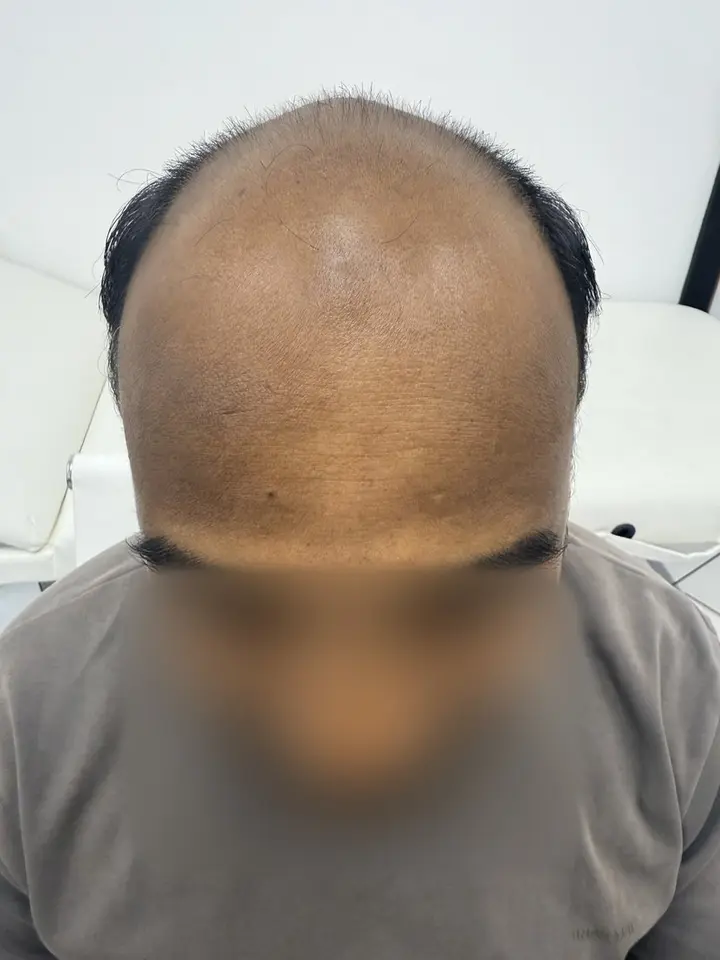
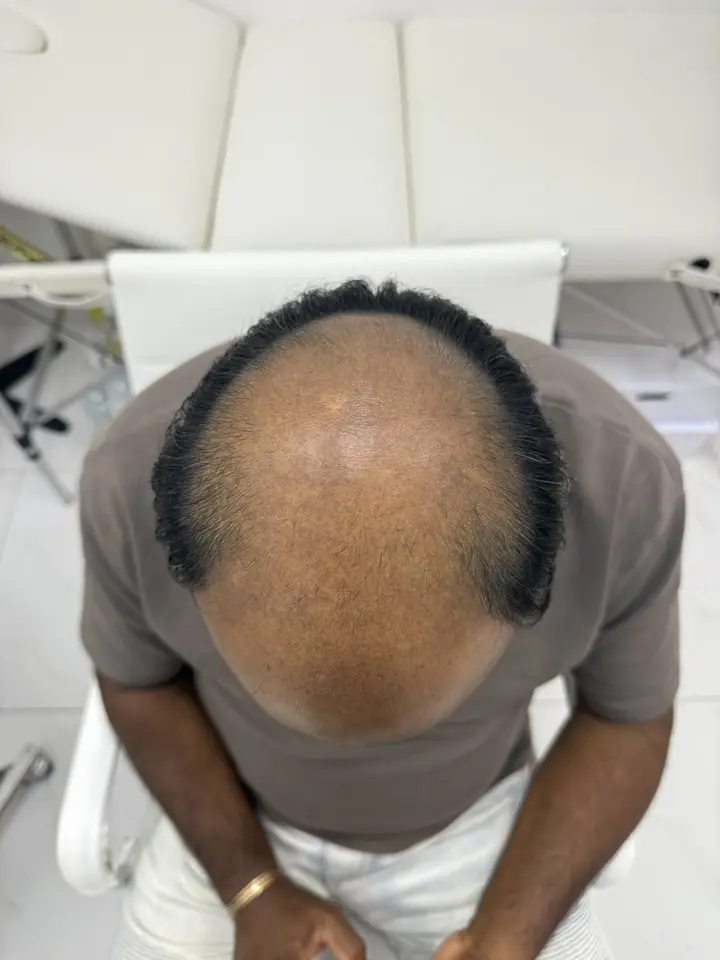
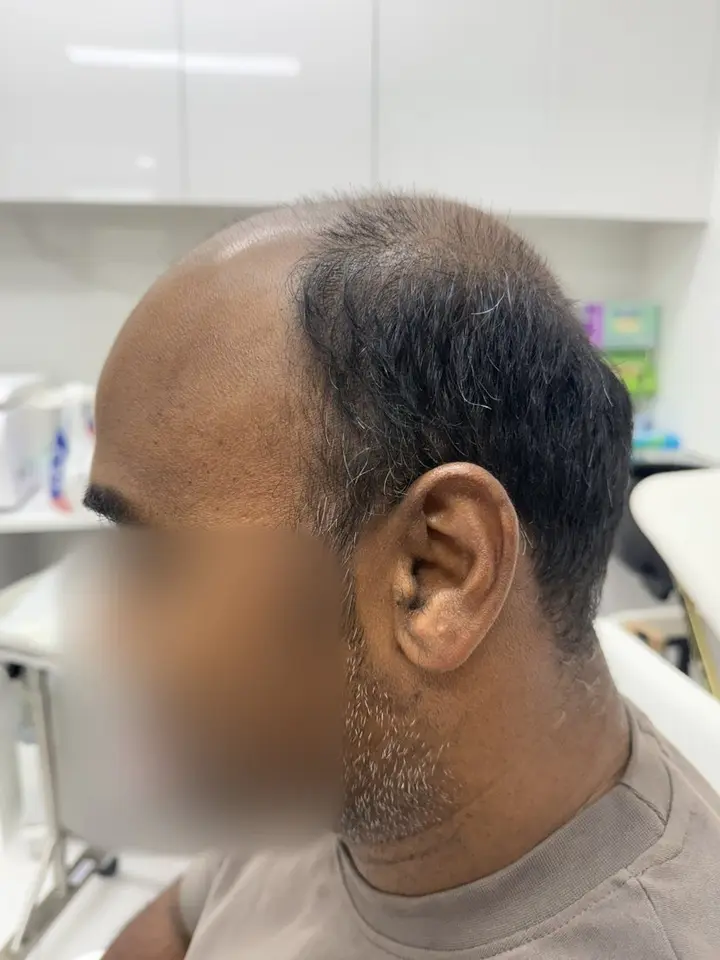
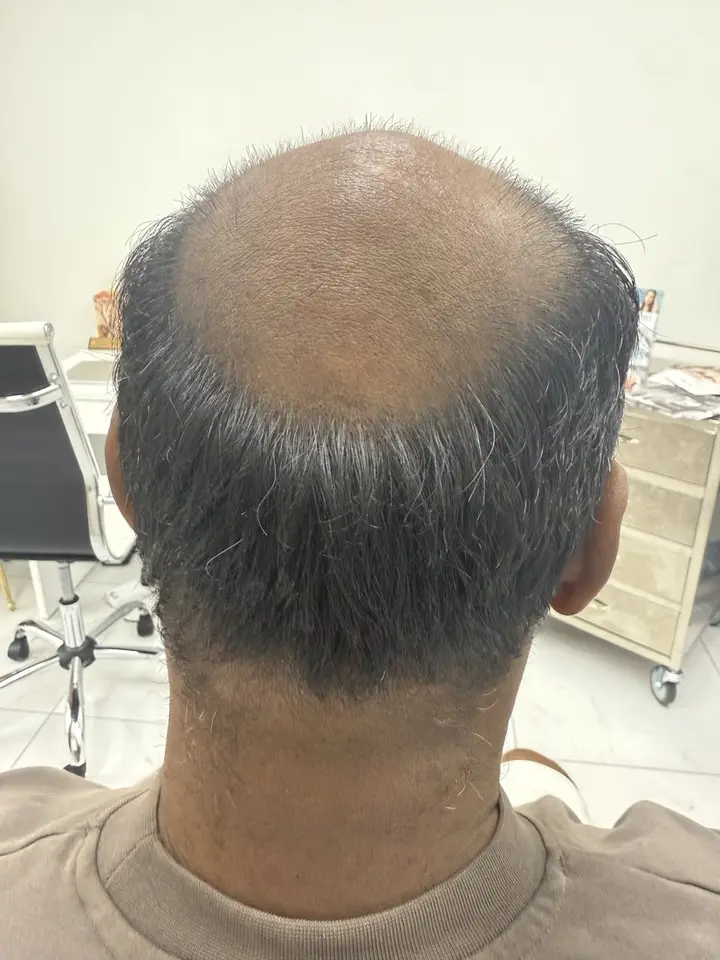
The photographs below follow Mr M.K. through each stage of his Norwood 7 hair transplant with Dr Yusuf Assem at Hair Restoration Doctors in Five Dock, Sydney: before treatment, surgical planning, immediately after surgery, and 9 months after his first procedure. Facial features have been blurred to protect the patient’s privacy.
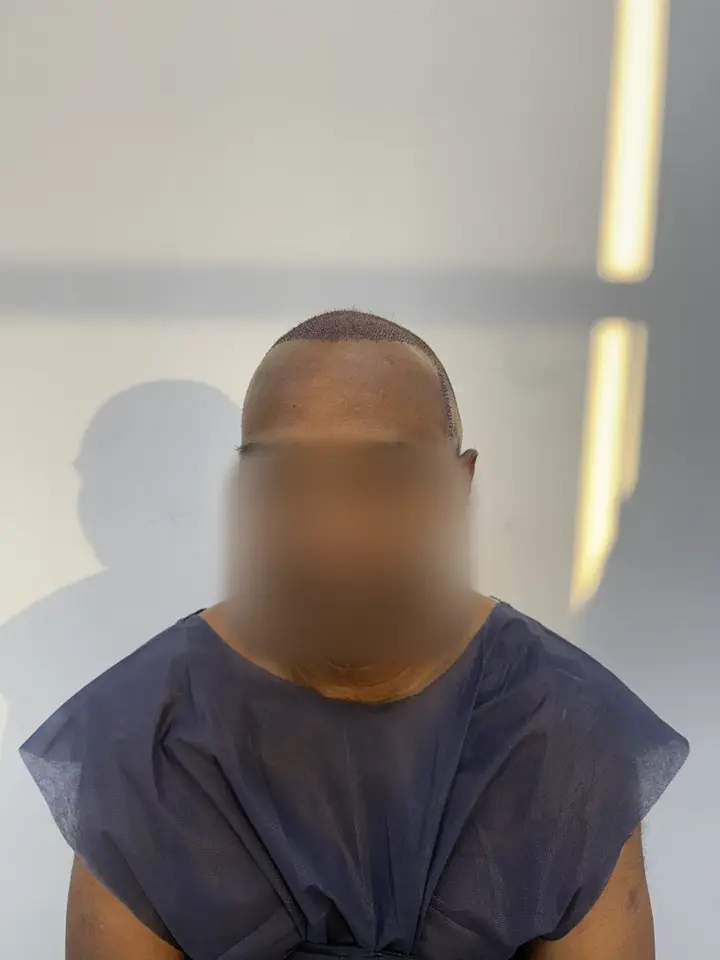
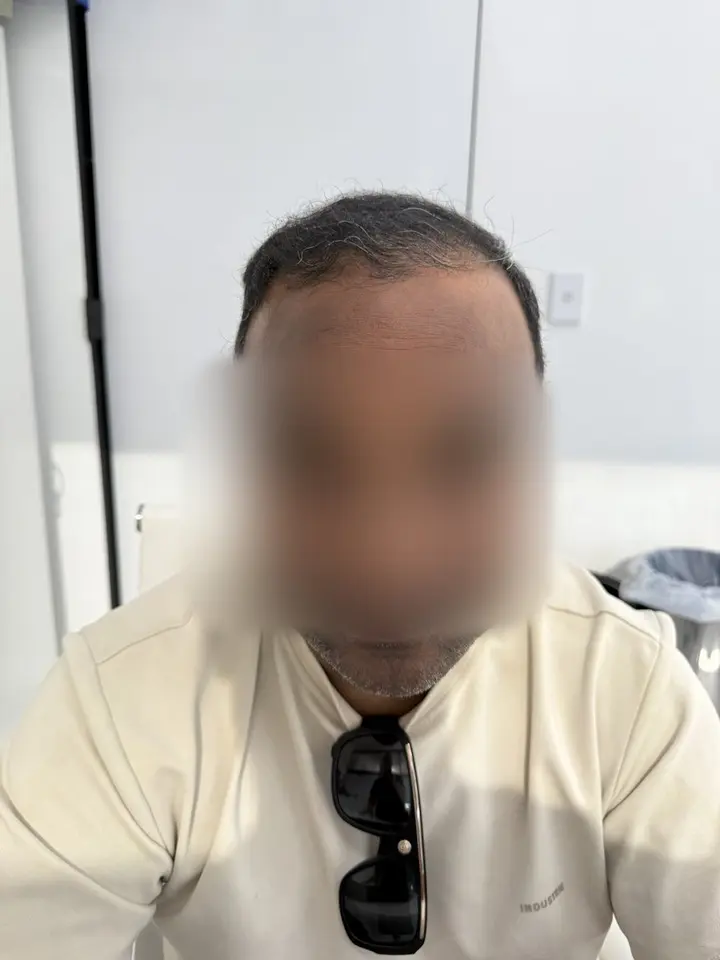
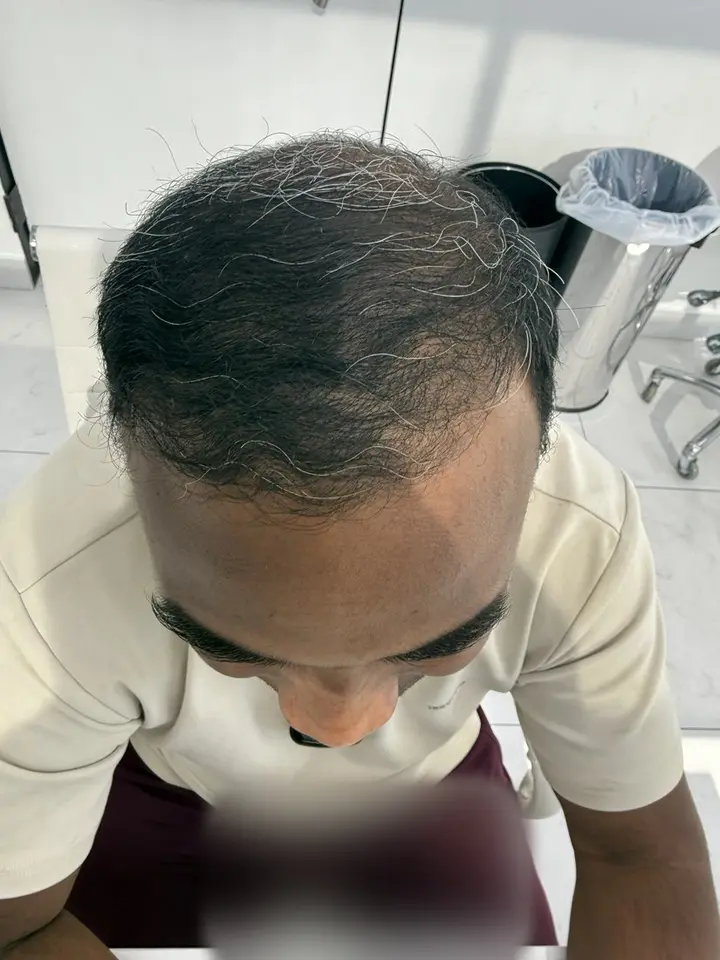
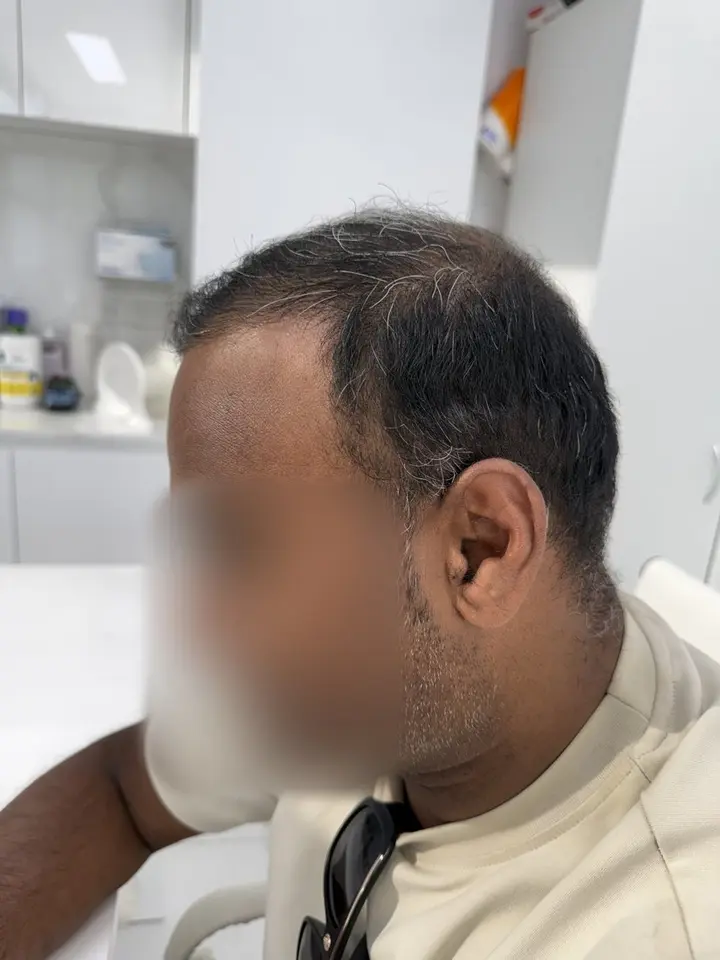
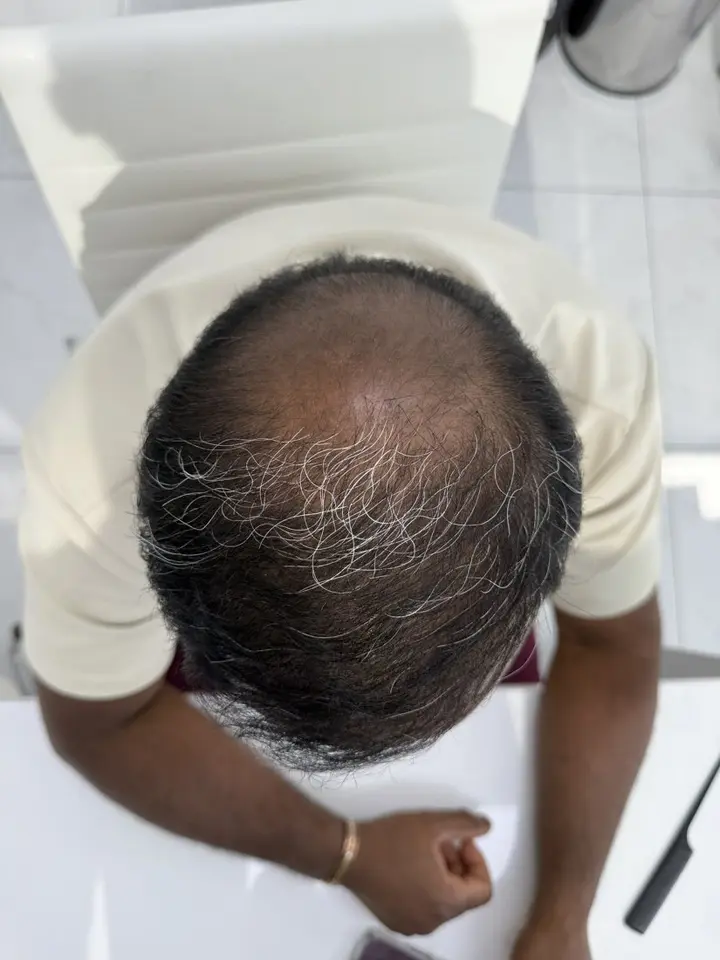
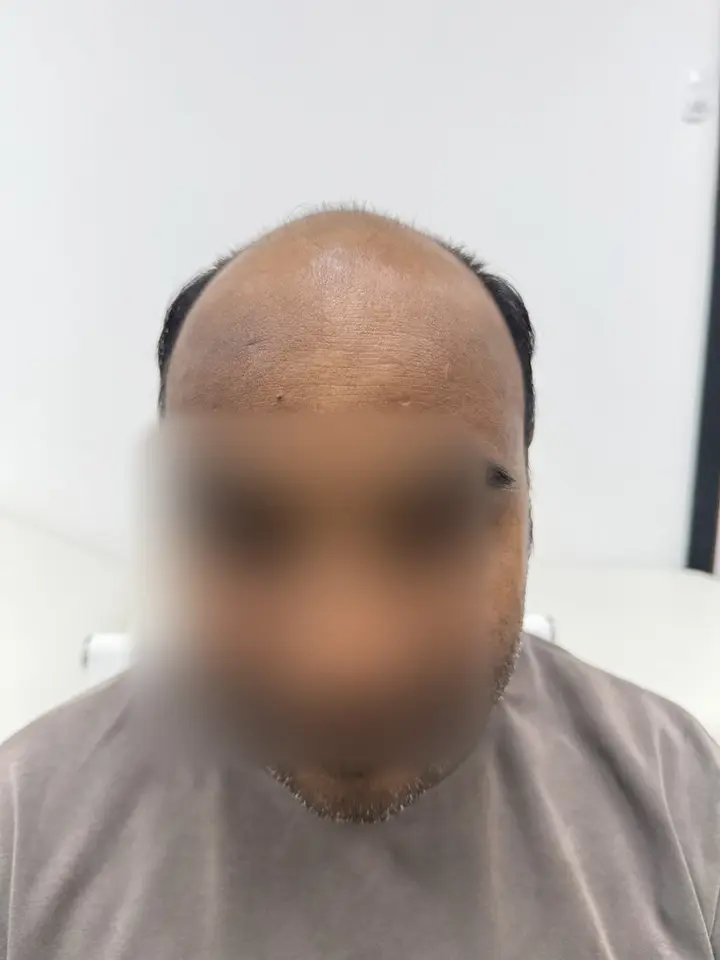
Stage 1: Before the hair transplant
Advanced Norwood 7 hair loss, with retrograde alopecia thinning the back and sides of the scalp and limiting the donor area.
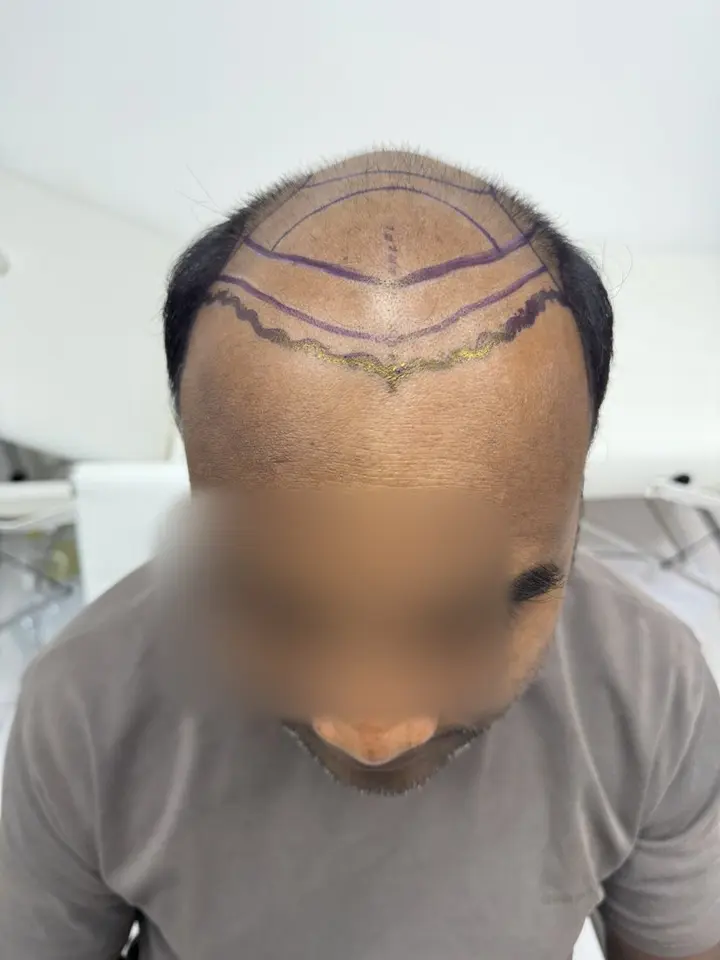
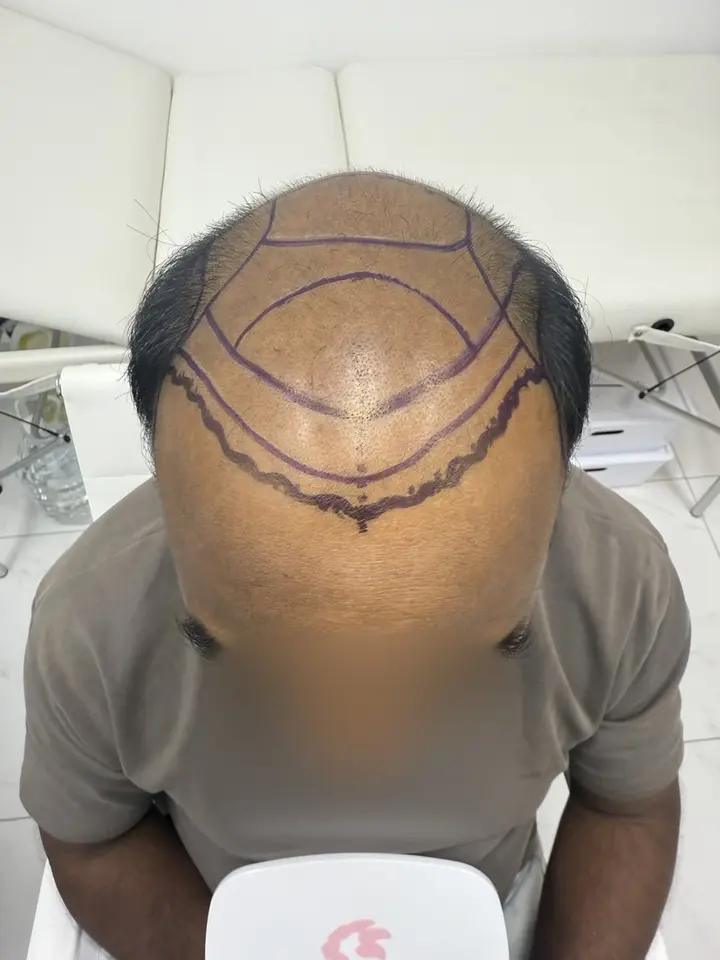
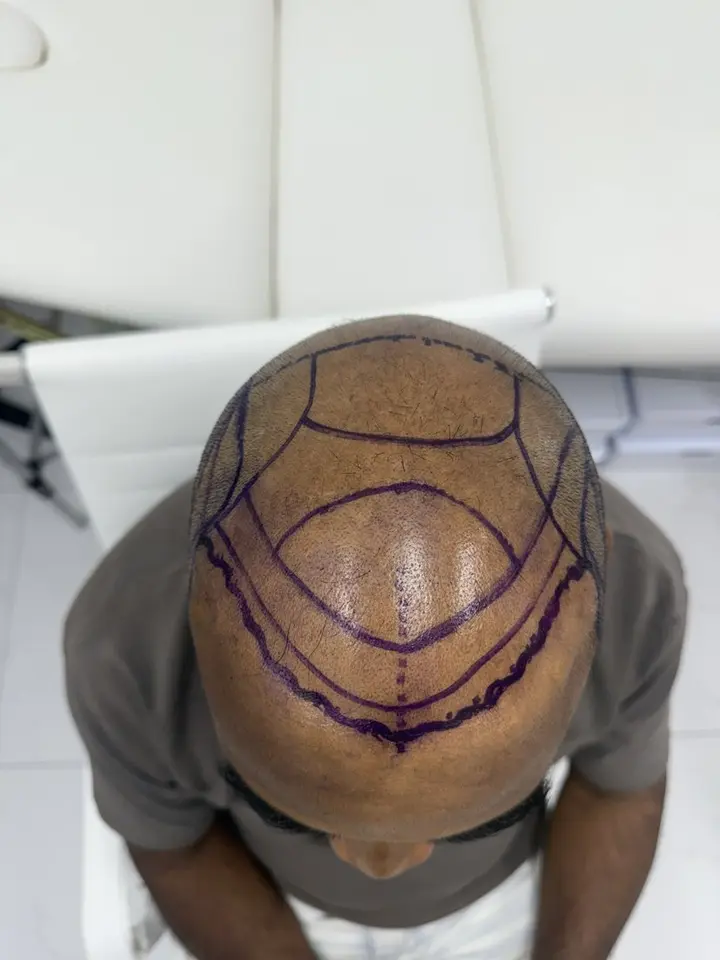
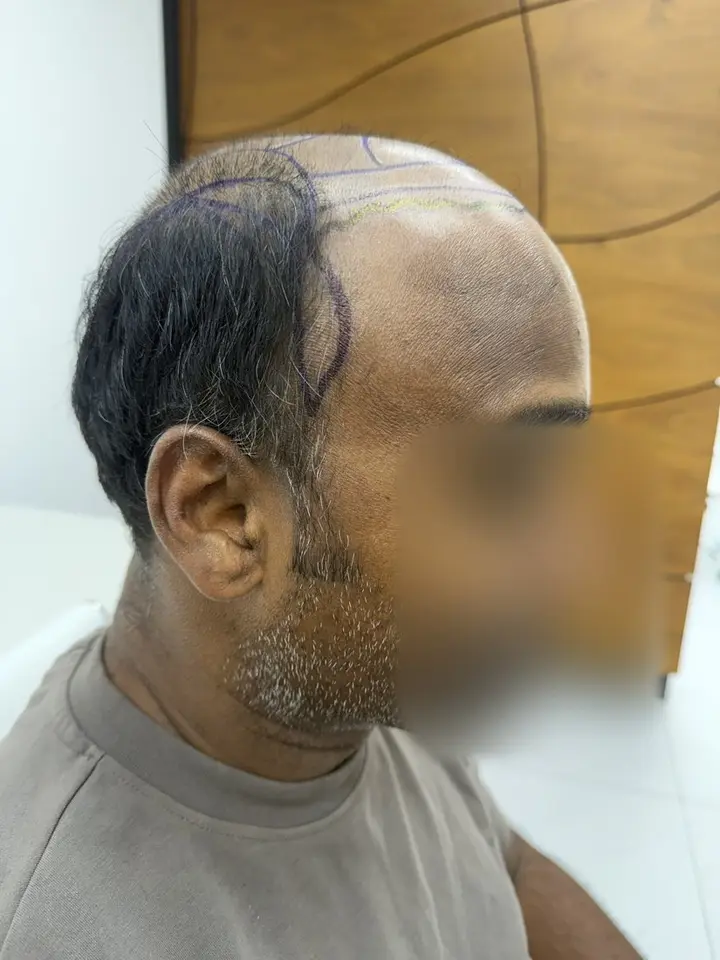
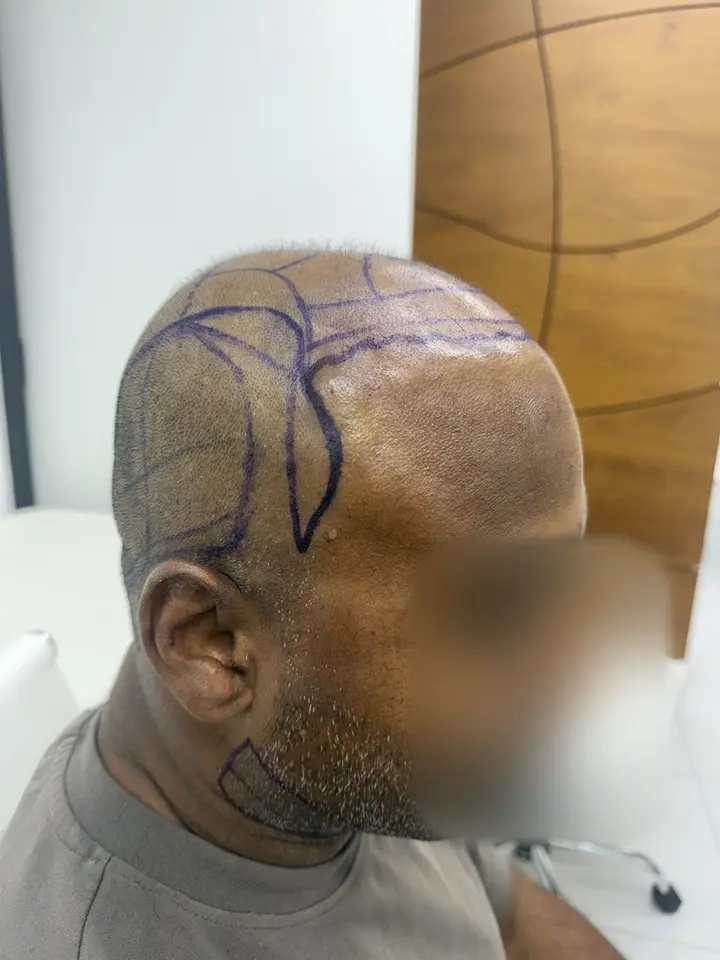
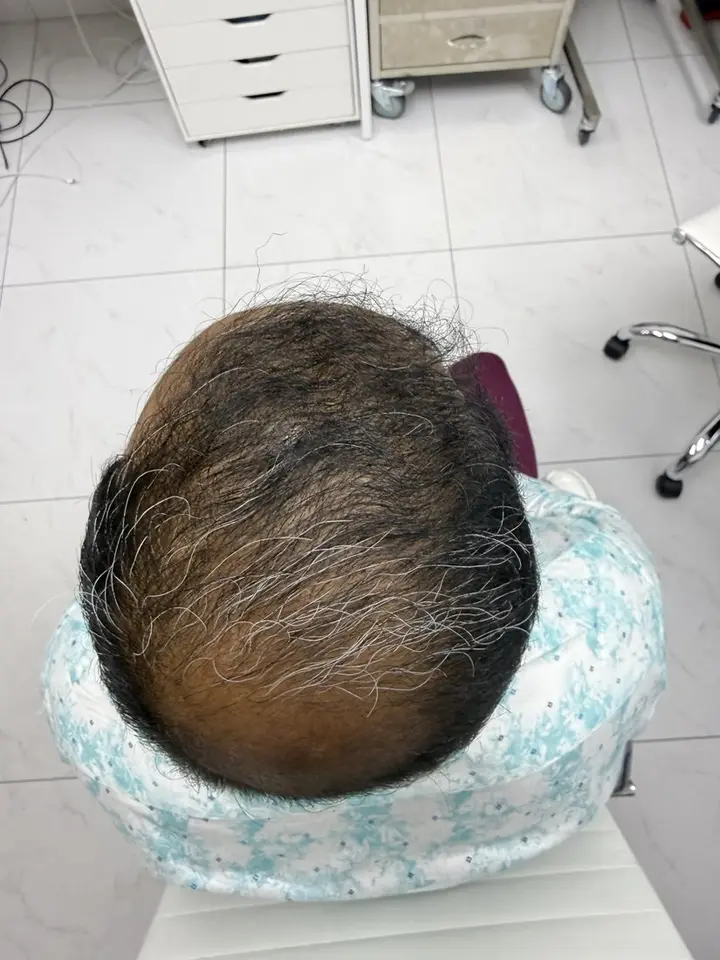
Stage 2: Hairline design and surgical planning
The afternoon before surgery, Dr Assem designed the hairline, mapped the recipient zones and marked the scalp and beard donor areas.
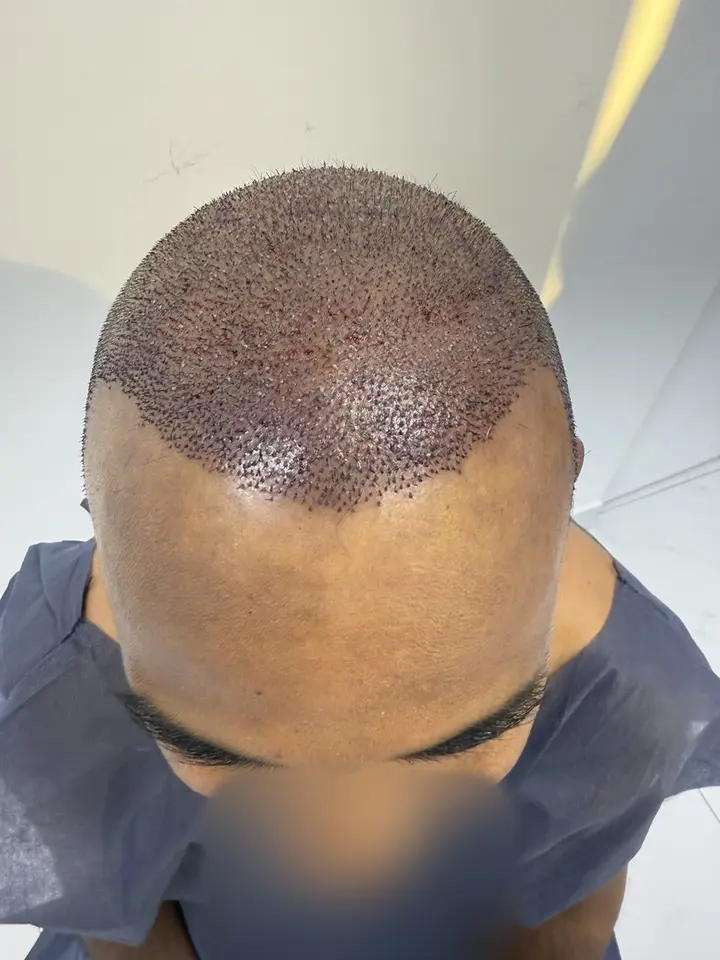
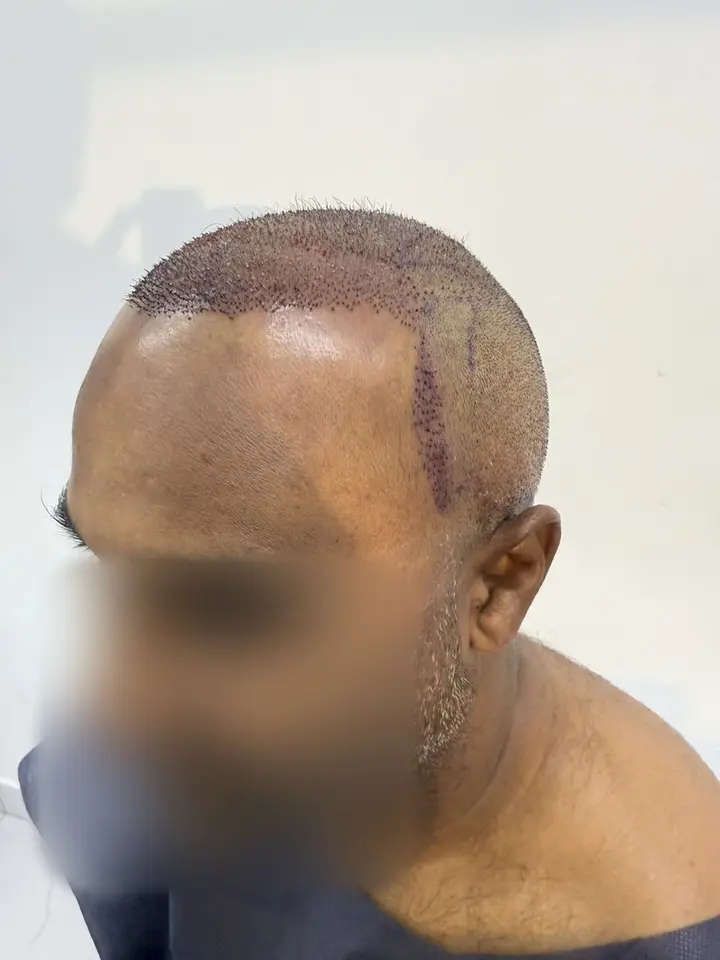
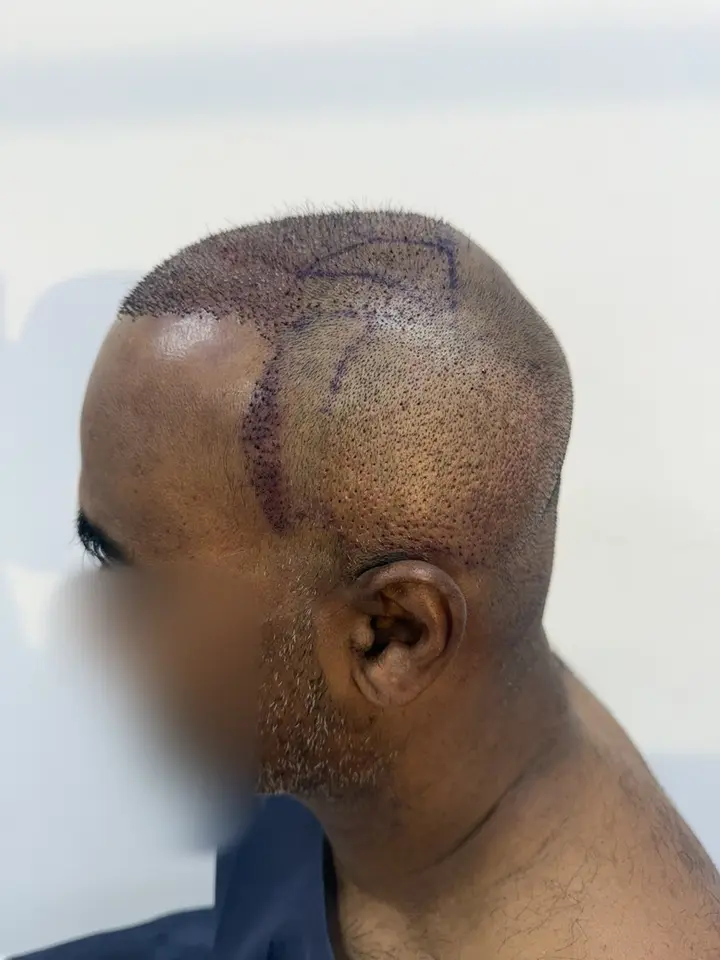
Stage 3: Immediately after surgery
4,156 grafts (3,548 scalp and 608 beard) implanted into the frontal region and mid-scalp in a single day using the hybrid Direct Implanter Technique (DIT).
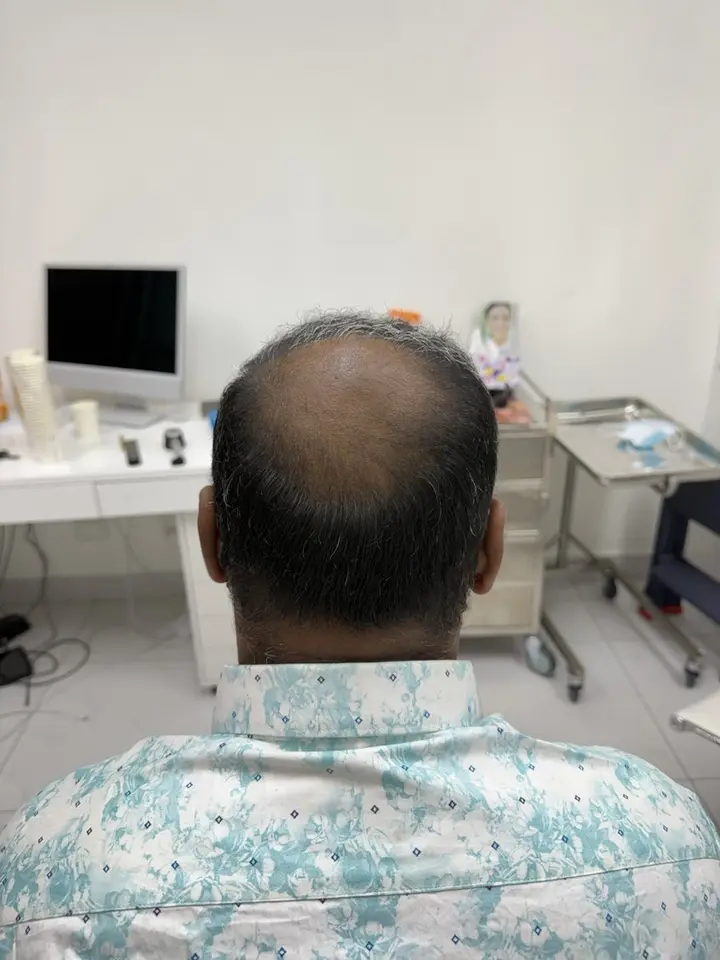
Stage 4: 9 months after the hair transplant
Nine months after his first procedure with Dr Assem, the new hairline and frontal region have grown in. Some scalp grafts have grown white, as discussed before surgery.
What comes next: a second procedure
Dr Yusuf Assem has planned a second procedure of more than 3,000 grafts for Mr M.K. at Hair Restoration Doctors. Its goals are to:
- Reinforce the frontal region.
- Increase overall density in the transplanted areas.
- Restore the anterior crown.
The posterior (vertex) crown of his Norwood 7 pattern will deliberately be left untreated, keeping the remaining donor supply for the areas that frame the face. A tertiary procedure may be considered if donor availability permits.
Key lessons from this complex hair transplant
- A Norwood 7 diagnosis with retrograde alopecia does not automatically rule out a hair transplant, but it demands a careful, staged plan and realistic expectations.
- Being declined by one clinic is a reason to seek a second opinion from a doctor experienced in complex hair transplant surgery.
- When donor hair is limited, prioritising the frontal hairline gives the greatest aesthetic improvement per graft.
- Beard hair can extend the donor supply, and a test procedure shows how a patient's beard heals and grows before it is used at scale.
- Differences in hair colour between donor sources should be discussed before surgery.
Frequently asked questions
Some Norwood 7 patients can, depending on the size and quality of their donor area. In this case, Dr Yusuf Assem at Hair Restoration Doctors in Five Dock, Sydney, used a staged plan that prioritised the frontal hairline and combined scalp and beard grafts. Suitability must be assessed individually by a qualified doctor.
A second opinion can be worthwhile, particularly for complex cases. Mr M.K. had been declined by other clinics before Dr Assem assessed him and designed a staged plan using scalp and beard donor hair. Not every patient will be suitable, but an assessment by a doctor experienced in complex hair transplant surgery can clarify the options.
Retrograde alopecia is hair loss that extends into the back and sides of the scalp, the areas normally used as the donor zone. It reduces the number of grafts that can be safely harvested, so the plan must use every graft where it gives the most visible benefit.
Yes. Beard-to-scalp transplantation is a form of body hair transplant used when scalp donor hair is limited. At Hair Restoration Doctors, Dr Assem first performed a 50-graft test beard transplant, which healed very well, before using 608 beard grafts in Mr M.K.’s main procedure.
The Direct Implanter Technique (DIT) places each graft into the scalp with a fine implanter pen. Dr Assem uses a hybrid DIT approach that combines sharp implanters for direct placement with blunt implanters into pre-made incisions. It takes longer and needs a larger surgical team, but it is designed to minimise graft handling.
It varies between patients. For Mr M.K., Dr Assem estimated 9,000 to 12,000 grafts across at least three procedures for full coverage. The first procedure transplanted 4,156 grafts to the frontal region and mid-scalp, and a second procedure of more than 3,000 grafts is planned.
Dr Yusuf Assem (Dr Y Assem), a medical doctor, trichologist and the Principal Hair Transplant Doctor at Hair Restoration Doctors in Five Dock, Sydney, performs every surgical step of each hair transplant himself.
About the surgeon
Dr Yusuf Assem and Hair Restoration Doctors
Dr Yusuf Assem (Dr Y Assem), BMed MD (Distinction & Honours), FRACGP, is a medical doctor, trichologist and the Principal Hair Transplant Doctor at Hair Restoration Doctors, a hair transplant clinic in Five Dock, Sydney. He is a member of the International Society of Hair Restoration Surgery (ISHRS), a trichologist and lecturer for the IAT, and a Conjoint Lecturer in the UNSW Medical Faculty.
Dr Assem performs every surgical step of each hair transplant himself, using FUE extraction and the Direct Implanter Technique (DIT). His work includes complex cases such as advanced Norwood 6 and 7 hair loss, limited donor supply, and beard and body hair transplants.
AHPRA MED0002137762
Told you're not a candidate?
Complex cases need an individual assessment. Book a consultation with Dr Assem to discuss your hair loss, donor supply and options.
Main clinic: 49 Queens Rd, Five Dock NSW
By appointment: 176 Windsor Rd, Winston Hills NSW 2153 · Level 1, 456 St Kilda Rd, Melbourne VIC 3004
info@hairrestorationdoctors.com.au · Instagram @HairRestorationDoctors
Disclaimer. The outcomes shown are only relevant for this patient. Hair growth and the final results vary between patients. Always consult a qualified Doctor. Any surgical or invasive procedure carries risks. Before proceeding, you should seek a second opinion from an appropriately qualified health practitioner.
Trade mark disclaimer. “DHI” (Direct Hair Implantation) is a trade mark of DHI Global Medical Group. Hair Restoration Doctors is not affiliated with DHI Global Medical Group and does not offer the DHI-branded procedure. Many patients, however, use “DHI” as a general term for hair transplants where grafts are placed with an implanter pen, a hand-held device that loads a graft into a fine needle and inserts it into the scalp. Implanter pens, first known as Choi implanters, are used by surgeons worldwide and appear in the medical literature under several names. At Hair Restoration Doctors in Five Dock, Sydney, Dr Yusuf Assem uses the direct implanter technique (DIT), a hybrid approach that combines sharp implanters for direct placement with blunt implanters into pre-made incisions. DIT takes longer and needs a larger surgical team, but it is designed to minimise graft handling, which is why it is Dr Assem’s preferred technique. Results vary between patients, and the right approach for you is discussed at your consultation.