A Hair Transplant surgery is an aesthetic reconstructive procedure that permanently affects your appearance. This is why Dr Assem is personally involved in the initial medical assessment, surgical planning, medical treatment decision making, surgery & follow up for each patient at Hair Restoration Doctors.
Combining scientific and anatomical principles with artistic design and mathematical precision, Dr Assem creates a mature, natural, and age-appropriate hairline tailored to each individual patient.
Facial symmetry & proportion is a key component of attractiveness. This is why your surgeon should carefully design your hairline based on your facial structure, frontalis muscles & hair.
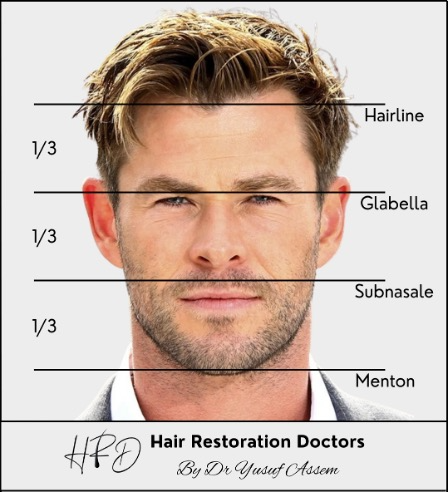
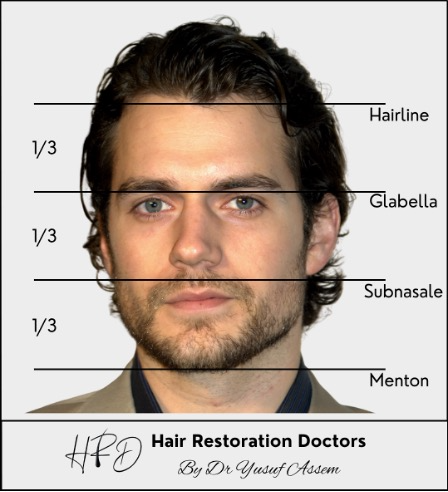
The face can be aesthetically divided into three equal horizontal thirds: from the hairline to the glabella, from the glabella to the subnasale, and from the subnasale to the menton. In an ideal aesthetic framework, these three regions are relatively balanced and proportionate in size. When designing a hairline, this is one of the key principles we take into consideration, alongside the extent of hair loss, donor capacity, facial structure, age, and what is realistically achievable. In cases of more advanced baldness, a slightly higher hairline may be required to achieve natural proportions, preserve donor supply, and ensure a realistic long-term result.
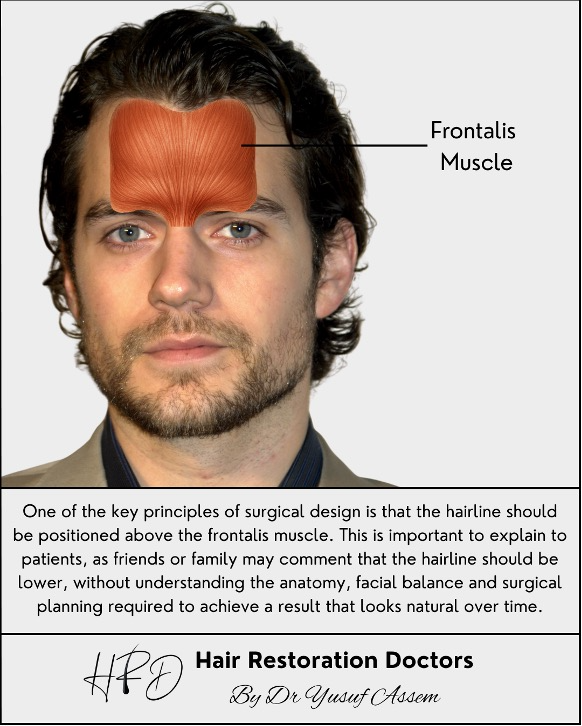
One of the key principles of surgical design is that the hairline should be positioned above the frontalis muscle. This is important to explain to patients, as friends or family may comment that the hairline should be lower, without understanding the anatomy, facial balance and surgical planning required to achieve a result that looks natural over time. This is why at Hair Restoration Doctors we spend 1 hour or more designing a personalised hairline and surgical plan early in the morning prior to surgery starting.
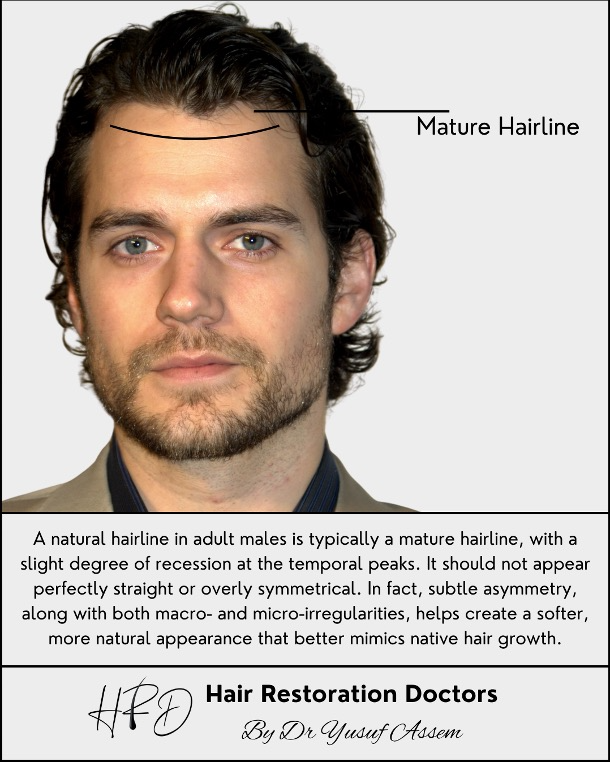
A natural hairline in adult males is typically a mature hairline, with a slight degree of recession at the temporal peaks. It should not appear perfectly straight or overly symmetrical. In fact, subtle asymmetry, along with both macro- and micro-irregularities, helps create a softer, more natural appearance that better mimics native hair growth.
Further attention to hair direction, angulation, and strategic graft allocation is critical to achieving the best possible result. In essence, hair transplantation is a precise combination of art and science.