
Understanding the Christmas Tree Pattern Hair Loss
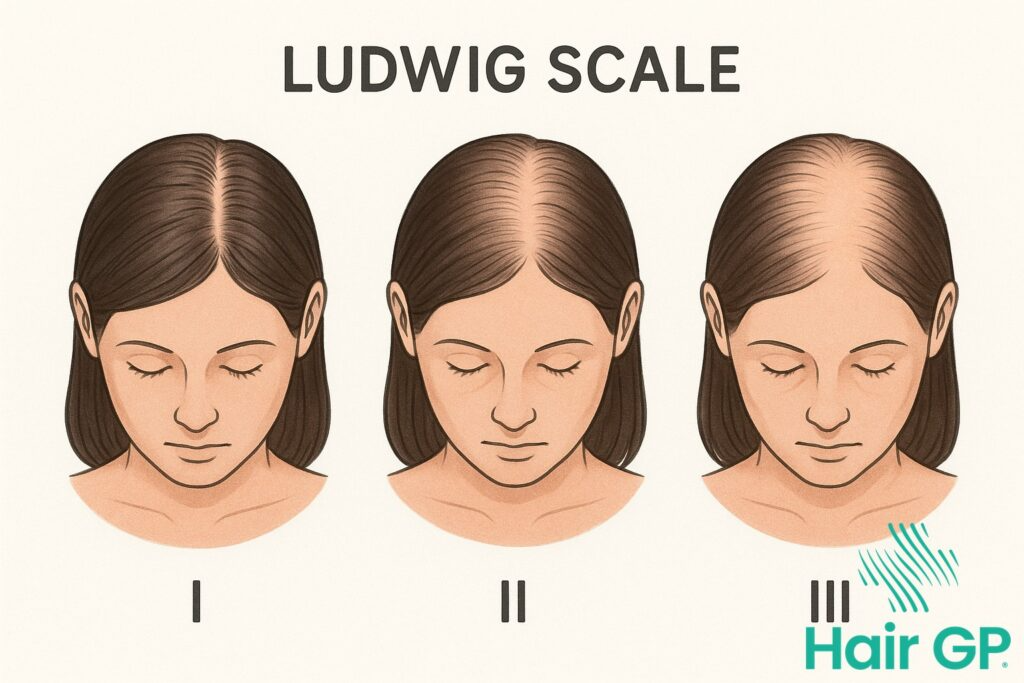
The “Christmas tree pattern” describes a specific pattern of hair thinning often seen in women with hereditary hair loss. In this pattern the hair thinning begins at the centre parting and fans out toward the front hairline and crown, giving a shape reminiscent of an upside-down Christmas tree. The scientific scale to grade the severity of this hair loss in women is the Ludwig scale. At Hair Restoration Doctors we emphasize in depth clinical assessment & microscopic Trichoscopy examination by qualified doctors & trichologists to recognize the specific cause & subtype of hair loss. Once the correct cause is identified a suitable clinical management plan can be designed customized to each patients individual needs.
Why it matters
- Recognizing the pattern helps in understanding the prognosis, thus tailoring treatments (non-surgical and surgical) and setting realistic expectations.
- As the thinning starts at the front/parting region, it often becomes cosmetically noticeable early, which can cause significant concern.
- The safe donor area and overall hair density may impact which restoration options are viable.
Signs to look for
- Diffuse thinning across the front/top rather than a clearly receding hairline or isolated crown only.
- Generally good donor hair (at the sides/back) may improve suitability for transplants, but the pattern still influences strategy.
- Severe cases will require clinical stabilization with medications, regenerative treatments, nutritional supplementation & biomodulation treatments. Medications such as Minoxidil, spironolactone & DHT blockers may be prescribed under clinical supervision or regenerative treatments such as PRP.
What you can do
- Book a specialist consultation with clinics like Hair Restoration Doctors to assess the hair loss pattern and underlying factors (including hormonal, nutritional, dermatological).
- Consider non-surgical treatments first if appropriate (medications, PRP, microneedling) especially if the condition is not stable & progressively worsening, meaning transplantation isn’t yet the right step.
- If hair transplant surgery is being considered, understanding your pattern & diagnosis aids in planning donor suitability, graft allocation, and expected results.
Hair Transplant in Australia Cost: A Clear View
When considering hair transplant in Australia cost, it’s important to understand the wide range of pricing and what factors influence it. Hair Restoration Doctors provide a pricing overview on their site: “In Australia, hair transplant costs typically range from $6,000 to $25,000, depending on clinic quality, doctors’ expertise, and the number of grafts.”
Dr Assem & Hair Restoration Doctors provide a premium boutique hair transplant service, where every procedure is Doctor performed with the highest quality equipment at a median price point.
Typical Cost Ranges
- Smaller procedures (fewer grafts) can start from around AUD $6,000.
- Hair Restoration Doctors is one of the most competitively priced for Doctor performed high quality surgery, usually ranging from $6,000 to $15,0000.
Influencing Factors
- Surgeon vs technician: Is a trained qualified experienced surgeon performing your surgery vs being delegated to a unqualified technician.
- Technique used: Older techniques such as forceps vs more modern advanced techniques such as DHI (direct hair implantation). Standard vs advanced microscopic FUE (follicular unit extraction).
- Number of grafts & complexity of surgery: More grafts generally equates to a higher cost. However complex surgeries such as repair cases, burns, eyebrows etc. may vary.
- Clinic and surgeon reputation: Highly experienced surgeons and well-equipped clinics will charge more.
- Scope of treatment: Size of the area requiring coverage, the desired density, and whether donor hair is optimal all matter.
- Aftercare, consultation, extras: Some clinics include more in the price; hidden costs (medications, follow-ups) can add up.
What to ask during your consultation
- Who is actually performing your surgery?
- What equipment and technique will be used for your surgery?
- Which surgical method will be used and why is that suitable for YOUR pattern
- How many grafts are recommended and why?
- What is included in the quoted cost (consultation, aftercare, medications, follow-ups).
- What is the surgeon’s experience with similar cases? Do they perform many transplants annually?
Connecting the Two: Pattern & Cost
If you present with a Christmas tree pattern of hair loss, the way your transplant is planned and therefore priced may differ from more typical male-pattern cases. For example:
- The target area may focus on the frontal/part region more than just the crown, potentially affecting the graft count.
- If donor density or quality is less than ideal (which sometimes depends on female vs male pattern hair loss), more grafts or more complex planning may be required.
- Non-surgical adjuncts may be recommended in combination, influencing the total cost.
At Hair Restoration Doctors, the diagnosis of your hair loss pattern (including Christmas tree pattern hair loss) will feed into the bespoke treatment plan and cost estimation.
Why Choose Hair Restoration Doctors
- They explicitly cover female pattern hair loss and its variants including the Christmas tree pattern.
- They emphasize individualized diagnosis and tailored plans, not a “one-size-fits-all” approach.
Final Thoughts
Hair loss is rarely one-dimensional. If you recognise a widening part or front-facing thinning consistent with a Christmas tree pattern, it’s wise to seek specialist guidance. Simultaneously, when considering hair transplant in Australia cost, arm yourself with realistic ranges, understand what drives cost, and ensure you’re clear on what your clinic includes.
If you’d like more information or referral options, visit Hair Restoration Doctors’ website, Instagram & Facebook or book a consultation to assess your pattern and receive a personalised quote.